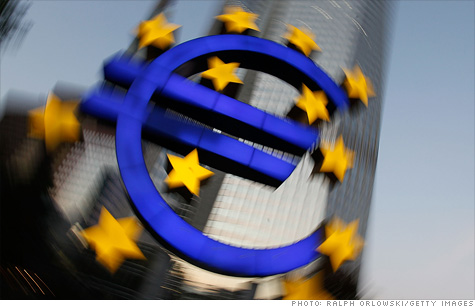
The ECB cut a key interest rate as economic conditions deteriorate in the wake of the deepening debt crisis.
NEW YORK (CNNMoney) -- The European Central Bank cut interest rates and announced a series of measures to ease credit conditions as the eurozone debt crisis continues to take a toll on Europe's economy.
The central bank lowered its main interest rate to 1% from 1.25%. That marked the second interest rate cut since November, when the ECB first began taking measures to help stimulate the economy and boost lending.
It also brings rates back to a level not seen since 2009, when the global financial system was in crisis.
The move comes as economic conditions in Europe have deteriorated sharply, with ECB President Mario Draghi forecasting a mild recession at the bank's last policy meeting.
"Intensified financial market tensions are continuing to dampen economic activity in the euro area and the outlook remains subject to high uncertainty and substantial downside risks," said Draghi in a statement, following the rate cut announcement.
The ECB also announced several "non-standard measures" aimed at easing credit conditions.
The bank will now accept certain asset-backed securities with the "second best rating" as collateral for bank loans. It will also cut its reserve ratio requirement for banks to 1% from 2% to free up capital and boost lending.
In addition, the ECB will hold two 3-year refinancing operations to replace 1-year facilities that are due to expire this month, and take other steps to support euro area money markets.
The ECB announced its actions hours before European Union leaders are set to gather in Brussels for a crucial summit to discus ways to save Europe's troubled currency.
The politicians are expected to begin the process of forming a so-called fiscal union among the 17 nations that use the euro, and possibly the full 27 member EU.
The ECB has been under pressure to intervene more aggressively in shaky sovereign debt markets. While the bank has so far resisted, Draghi hinted last week that additional steps could be taken if governments agree to a "fiscal compact."
The ECB resumed buying government bonds on a limited basis earlier this year as part of an emergency program to keep yields in check.
Italy and Spain have seen their borrowing costs rise to unsustainable levels, although rates came down last week. The fear is that those countries could fall victim to the debt crisis that has already taken down Greece, Ireland and Portugal.
The ECB, which has the ability to print money, is seen as the only European institution with the financial firepower to restore market confidence and stabilize borrowing costs for troubled EU governments.
But the bank's leaders have been divided on how to proceed, with its German stakeholders deeply opposed to buying bonds.
Critics say printing money will lead to inflation and bailing out governments will create a dangerous "moral hazard."
In response, supporters of greater intervention say the euro currency may not survive the crisis unless the ECB becomes a lender of last resort for member states.
European stock markets held modest gains after the widely expected rate cut. The FTSE 100 (UKX) in London was up 0.3%, the DAX (DAX) in Frankfurt was flat and the CAC 40 (CAC40) in Paris rose 0.2%
Stocks on Wall Street slid in early trading as investors parsed through the news.�
First Published: December 8, 2011: 7:57 AM ET
Source: http://rss.cnn.com/~r/rss/money_topstories/~3/Nzuox2OTWGs/index.htm
business news news latest news us news key news best news economic news finance news economic news world us news

No comments:
Post a Comment